Neurons: The Currency of Thought
The brain has ~86 billion neurons. But that number alone doesn't make us special — elephants have more. What matters is HOW they connect.
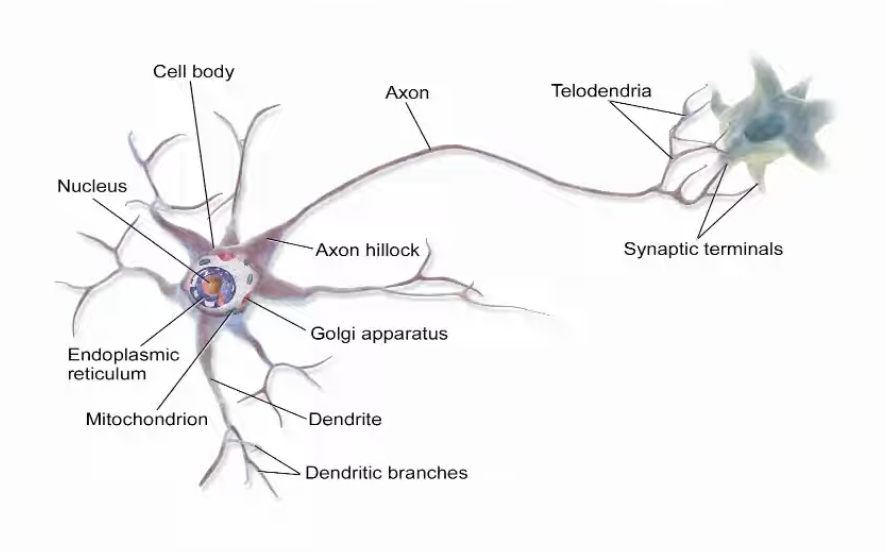
A single neuron: dendrites receive, soma integrates, axon transmits
A neuron is a highly specialized cell with three main parts:
• Dendrites — branching input ports that receive signals from other neurons (think: antennae)
• Cell body (soma) — integrates all incoming signals
• Axon — the single output cable that sends signals to other neurons (can be up to 1 meter long!)
⚡ When a neuron receives enough input, it fires an action potential — a rapid voltage spike (~1 ms). Action potentials are the universal language of the brain: the 'currency of information processing.'
All action potentials look the same — same shape, same size, ~+40 mV peak. Information is encoded in the timing and rate of spikes, not the amplitude. A neuron firing 80 times per second is sending a different message than one firing 10 times per second.
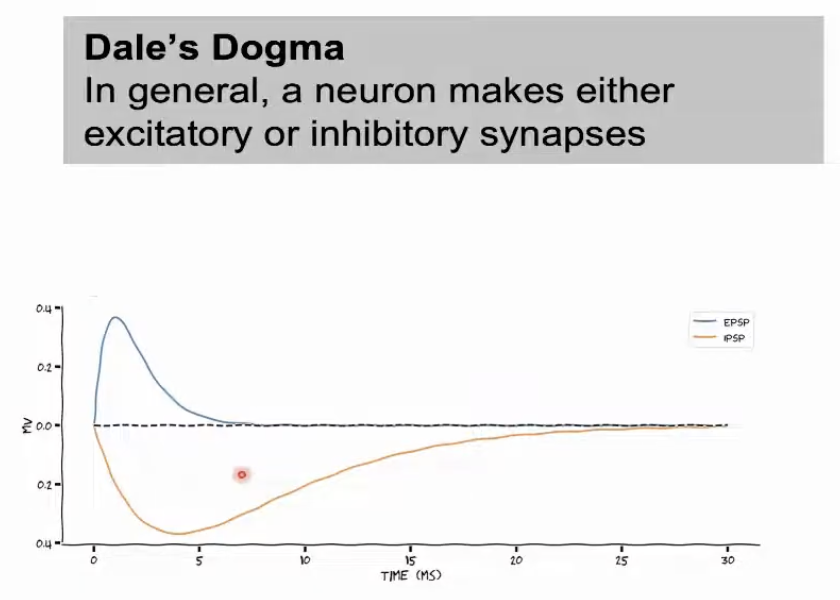
Dale's Dogma: each neuron releases only one type of neurotransmitter
Excitatory vs Inhibitory neurons (Dale's Dogma):
Neurons are classified by what they release:
• Excitatory neurons release glutamate → increases the chance the receiving neuron fires
• Inhibitory neurons release GABA → decreases the chance the receiving neuron fires
Most neurons are exclusively one or the other — this is called Dale's Principle. The balance between excitation and inhibition is crucial for normal brain function.