The Brain's Large-Scale Wiring
In the previous lesson you saw that individual neurons wire by function — similar neurons find each other across distance. Does the same principle hold when you zoom out to the level of entire brain regions? Yes. And the map is stunning.
First — what is a region? In the last lesson you were looking at minicolumns of ~100 neurons. A region is the next level up: a cluster of millions of neurons that share a primary job, physically located together in one spot.
Think of the brain as a company. Each region is a department — Finance, HR, Operations — with a specific function and a specific office.
• Visual cortex (back of the head) — processes everything you see
• Motor cortex — controls voluntary movement
• Broca's area — produces speech
• Prefrontal cortex — planning, decision-making, self-control
The question is: how do these departments talk to each other? Is it random — every department calling every other equally? Or is there structure?
Scientists use tracer studies to find out: inject a chemical into one region and it travels along axons to wherever that region projects — revealing its direct lines. Do this across the whole cortex and a map emerges.
The answer is definitively not random:
• Modular — regions cluster into divisions that talk densely within the group, sparsely outside it. Like teams within a company — Marketing talks to Marketing constantly, rarely calls Engineering.
• Hierarchical — some regions are executive hubs that almost everything routes through. Damage a hub and whole systems break.
This structure is what creates the specialised brain regions we take for granted. Without it, you'd just have a uniform soup of neurons — no vision, no language, no memory. Just noise.
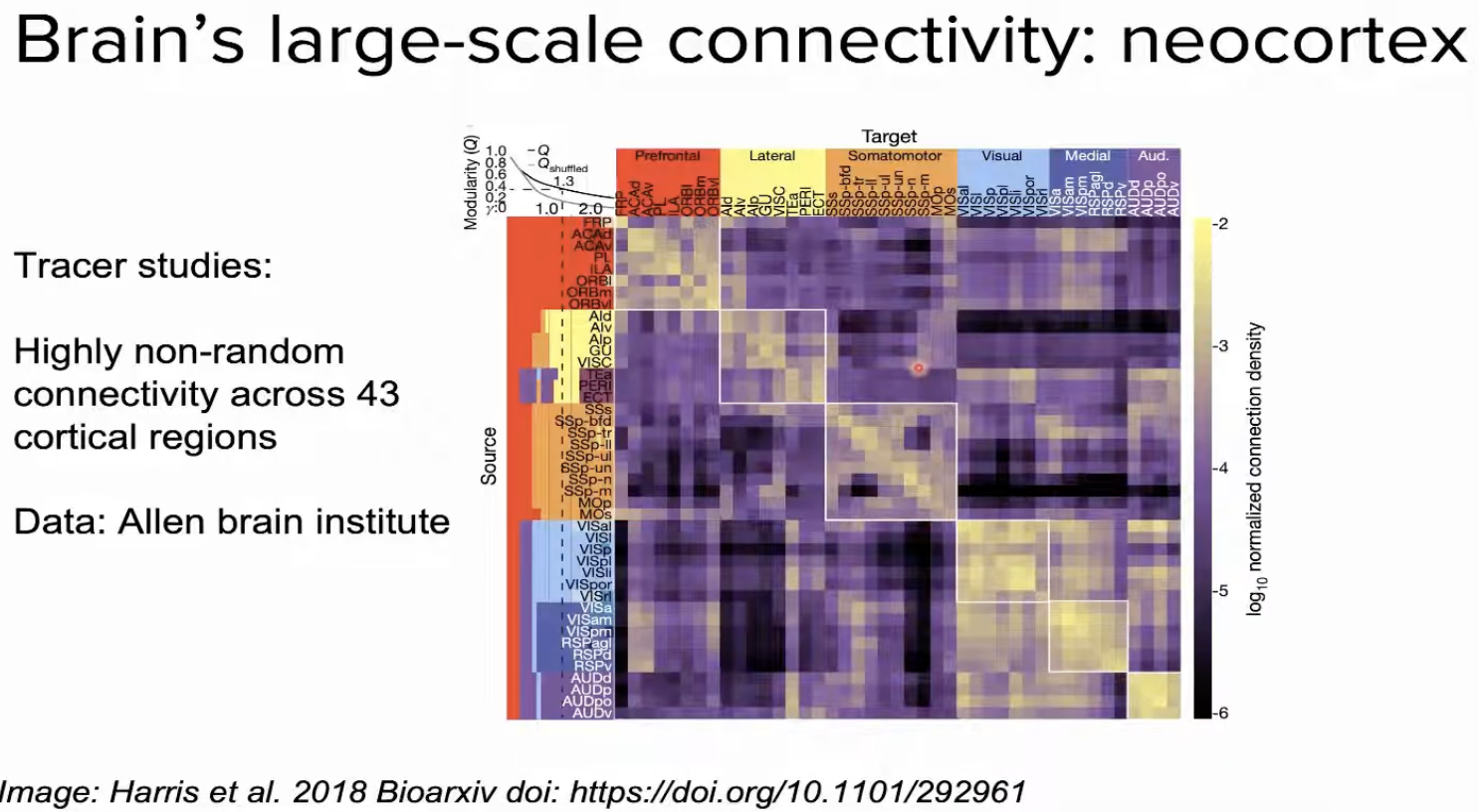
Each row is a source region, each column is a target. Yellow = dense connection. The blocks of yellow reveal the modular structure — friend groups of regions.
To feel the scale of what's being wired:
• ~86 billion neurons
• ~10 trillion synapses
• ~10,000 connections per neuron — in and out
• ~100,000 miles of axon — enough to circle Earth 4 times
• Signals travel at ~220 mph
No single number is the point. It's the combination — dense, delayed, dynamic, structured — that makes the brain unlike anything else we know.
Put it all together and the brain is a network of networks: local regions each running their own internal rules, connected by long-range pathways. It's the interaction between local and global activity that generates thought, perception, and behaviour. Neither level alone is enough.
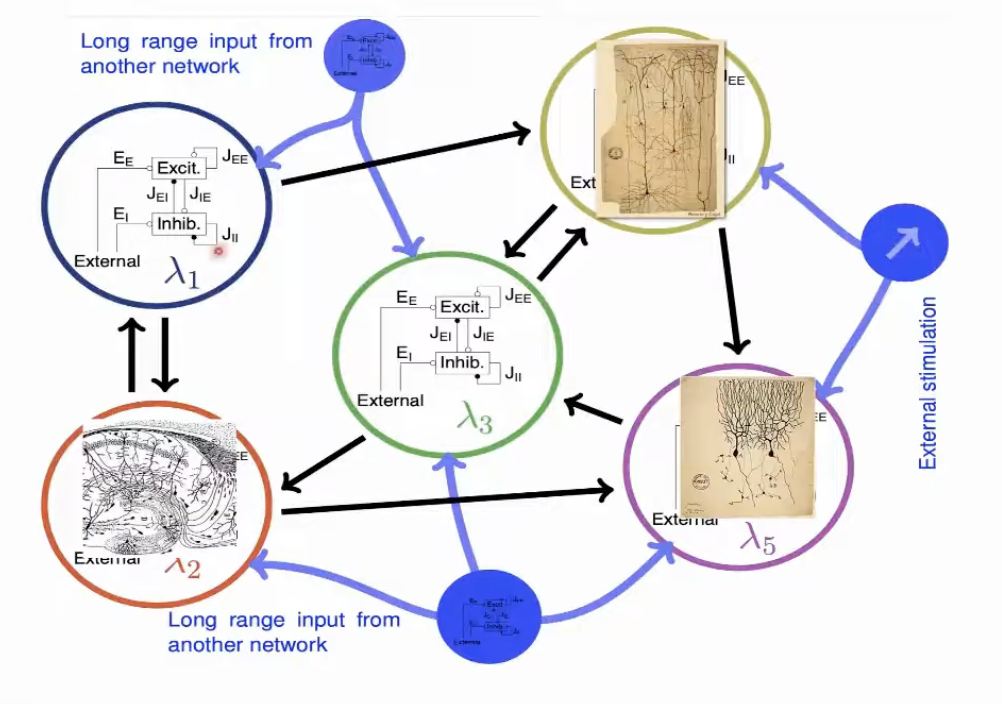
Local E/I circuits + long-range connections = the full architecture of the brain
Here's something most people don't know: this large-scale map — which departments connect to which — is largely written in your DNA before you're born.
We know from twin studies: identical twins (100% shared DNA) have strikingly similar connectivity maps. Fraternal twins (50% shared DNA) are noticeably more different. The closer the DNA, the more similar the wiring. Your natural tendencies — how quickly you process language, how easily you regulate emotion, how well you navigate — are partly shaped by this inherited blueprint.
Your genes build the roads. Experience writes the traffic.
But it's not fate — which is exactly what the London taxi driver study shows (see the transition screen after this lesson).
Given all this complexity, how do scientists even study brain function? Three steps:
1. Record — measure neural activity while animals or humans perform specific tasks
2. Correlate — find which activity patterns match which behaviours
3. Perturb — temporarily silence a region and watch what breaks, to establish causation not just correlation
And increasingly, the brain is compared to machine learning — Reinforcement Learning mirrors the brain's reward circuits almost exactly. Understanding the brain helped build AI. Now AI is helping us understand the brain back.