Neurons & Graded Potentials
Neurons are the basic processing units of the nervous system. Everything the brain does — move, remember, perceive — happens through neurons communicating via electrical signals.
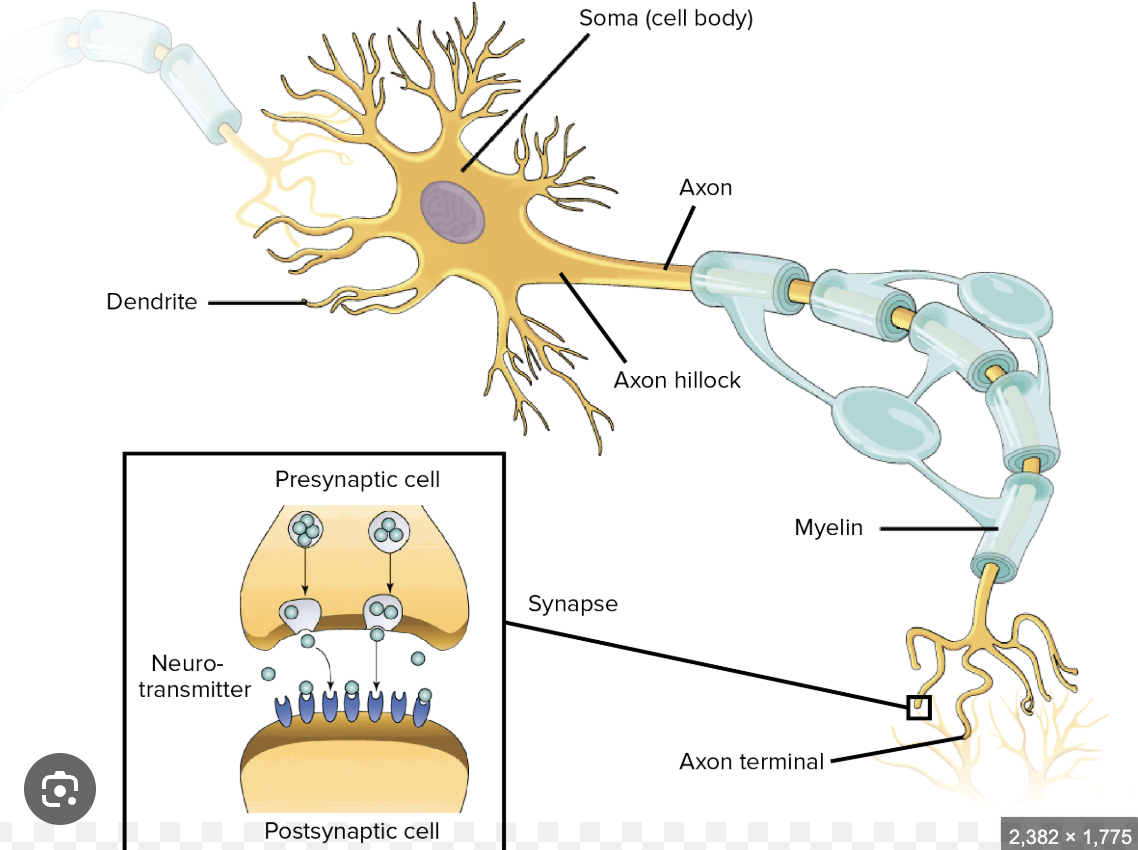
Anatomy of a neuron with a synapse zoom-in: dendrites receive, the soma integrates, the axon hillock decides whether to fire, and the axon terminal passes the signal across the synapse
A neuron has four key parts:
• Dendrites — the input ports. They collect incoming electrical signals from other neurons and carry them toward the cell body.
• Soma (cell body) — sums all the incoming signals. It's the decision-making centre.
• Axon Hillock — the trigger zone where the axon meets the soma. If the summed signal exceeds a threshold here, a spike is fired.
• Axon Terminals — the output end. They release neurotransmitters into the synapse, triggering a signal in the next neuron's dendrites.
Before a neuron fires a full spike, it receives graded potentials — small voltage changes that vary in size and duration depending on the strength of the input. Think of them as whispers: individually they may not be loud enough to act on, but multiple whispers arriving at the soma at the same time can add up.
When the sum of all graded potentials pushes the membrane voltage past a critical threshold, the neuron fires an action potential (spike). Below threshold: nothing happens. Above threshold: full spike.
💡 Graded potentials are the inputs — variable in size, they sum in the soma. Action potentials are the output — fixed and all-or-nothing. The soma is constantly doing a weighted vote: fire or stay silent.