Span & Linear Independence
You have two cars: 🚗 x goes East, 🚗 y goes North. Using both — any combination, any distance — you can reach every spot in the city.
Span = all the places you can reach by scaling and combining a set of vectors.
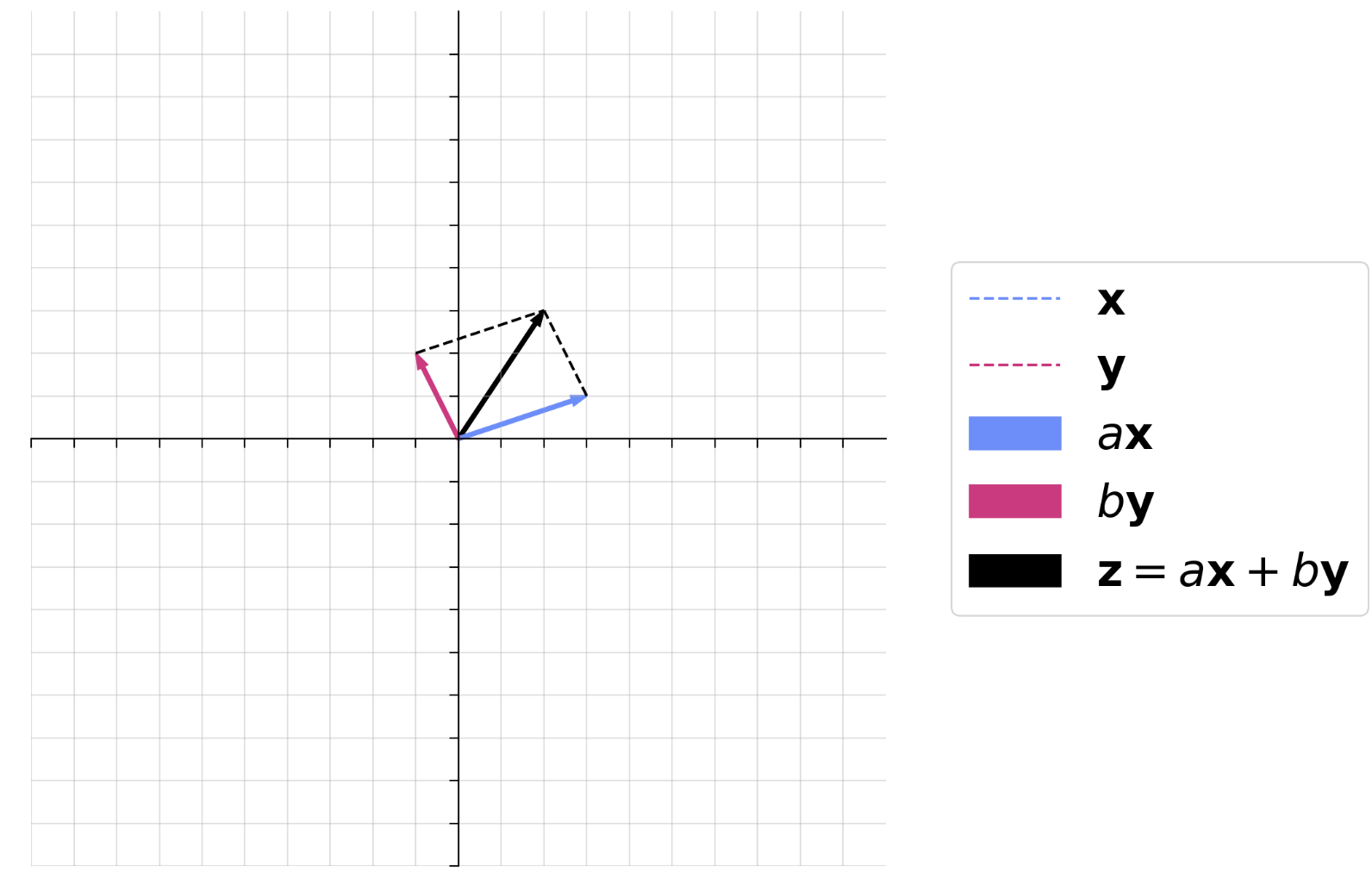
Two vectors pointing different directions span the whole plane. Two vectors pointing the same direction only span a line.
Now someone hands you a third car z that goes Northwest. Can z take you anywhere new? No — Northwest is just a mix of West + North, which you already had.
Z is a hitchhiker — redundant. That's linearly dependent: one vector can be built from the others.
The one test: If I removed this vector, would I lose any destinations?
• Remove z? Still reach everywhere → z is dependent
• Remove x? Can't go East → x is independent
Independent = every vector adds a genuinely new direction. Dependent = at least one is redundant — you can build it from the others.
WHY: Record 50 neurons → expect 50 independent signals → but neurons fire together, so the data actually lives in only ~5 truly independent directions. The other 45 are hitchhikers. This is exactly why PCA works.